

Laser Welding vs Emabond
Plastic Laser Welding Alternative for Complex Plastic Assemblies
Emabond RF welding gives manufacturers a lower-cost, material-flexible alternative to laser welding plastic while still creating a clean, non-contact weld with hermetic sealing potential.
Laser welding is often considered when manufacturers need a clean, precise, automated way to join plastic part
s. It can be a strong option when the material combination, optical access, weld path, and production volume all fit the process.
However, laser welding can also create challenges when the application involves opaque plastics, complex geometry, hidden weld lines, hermetic sealing requirements, or expensive laser-compatible materials.
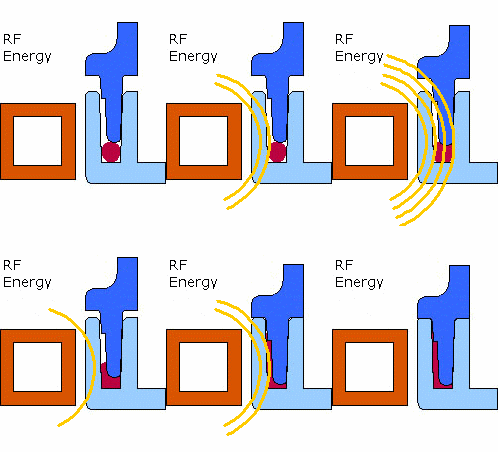
Emabond RF welding gives manufacturers another option. It uses radio frequency energy to heat a formulated susceptor material placed directly at the joint. This allows manufacturers to create strong, repeatable plastic welds without relying on laser transmission, laser absorption, or direct optical access to the weld line.
Quick Answer: When Is Emabond a Better Alternative to Laser Welding?
Emabond RF welding may be a better alternative to plastic laser welding when the application requires:
-
- Lower equipment cost
- Fewer laser-specific material restrictions
- Welding of opaque plastic parts
- Hidden or hard-to-access weld lines
- Complex 3D weld paths
- Continuous hermetic sealing
- Replacement of adhesives, gaskets, or fasteners
Laser welding is often chosen for clean and automated plastic joining. Emabond targets many of those same goals, but without requiring the same level of optical access or laser-compatible material selection.

Why Manufacturers Look at Laser Plastic Welding
Manufacturers often consider laser welding because it offers:
-
- Non-contact heating
- Clean weld appearance
- Good automation potential
- Low vibration compared to ultrasonic welding
- Better weld quality than some ultrasonic welds can achieve
- Reduced need for adhesives
- Reduced need for mechanical fasteners
- Precise heat input for certain applications
In many cases, the customer is not specifically looking for “laser welding.” They are looking for a better way to join plastic parts that isn’t ultrasonic welding.
The real goal is usually:
-
- A strong plastic weld
- A repeatable production process
- A clean assembly method
- A sealed plastic joint
- Less dependence on adhesives, screws, or gaskets
That is where Emabond RF welding becomes highly relevant.
Where Laser Welding Can Become Difficult
Laser welding can work very well, but the process often requires the part design and material selection to support the laser process.
High Equipment Cost
Laser systems may require the laser source, optics, beam delivery, guarding, fixtures, cooling, automation, and process development.
Special Materials
Many plastic laser welding applications require one material to transmit the laser and another to absorb it.
Optical Access
Laser welding requires the laser energy to reach the weld area, which can limit hidden or blocked weld paths.
Design Restrictions
Color, additives, material selection, wall thickness, clamping, and weld path geometry can all affect feasibility.
How Emabond RF Welding Is Different
Emabond RF welding uses radio frequency energy to heat a formulated susceptor material located directly at the joint.
The process works by:
-
- Placing Emabond susceptor material into the joint
- Fixturing the plastic parts under pressure
- Applying RF energy near the weld area
- Heating the susceptor locally at the joint
- Melting the surrounding thermoplastic surfaces internal to the joint
- Cooling the assembly under pressure to form the weld
The RF energy does not need to physically contact the weld line. The heat is generated at the joint through the susceptor material.
This makes Emabond useful for applications where laser welding may be limited by optical access, material transmission, material absorption, or part geometry.
Application Example: Sealed Plastic Housing
A manufacturer needs to weld a two-piece plastic housing. The assembly must be strong, repeatable, and sealed against leaks.
The customer wants to avoid:
-
- Adhesive cure time
- Adhesive process variation
- Screws
- Rubber gaskets
- Leak paths
- Long-term gasket compression issues
- Excess assembly labor
Laser welding is considered because it offers a clean, non-contact joining method. However, the application creates several concerns:
-
- The weld path is not fully visible to the laser
- The part geometry makes optical access difficult
- The plastics may require laser-compatible material grades
- The laser welding equipment cost is difficult to justify
- The customer wants a continuous seal around the housing
In this type of application, Emabond RF welding can provide a better fit.
By placing the Emabond susceptor directly in the joint, the weld can be created where the seal is needed. The RF energy heats the joint locally without requiring direct laser access to the weld path.
The result is a strong, repeatable plastic weld with hermetic sealing potential — without requiring costly laser equipment or special laser-compatible plastics.
Why Emabond Can Reduce Cost and Design Restrictions
Emabond can help reduce project cost and complexity in several ways:
-
- Lower equipment cost than many laser welding systems
- Less dependence on laser-compatible plastic grades
- Ability to weld opaque plastic assemblies
- No need for laser transmission through one plastic component
- No need for direct optical access to the full weld path
- Ability to support continuous seal paths
- Potential to eliminate adhesives, gaskets, screws, or potting
For manufacturers evaluating laser welding because they want clean automation, Emabond may deliver the same core benefit with fewer design restrictions.
Best-Fit Applications for Emabond RF Welding
Emabond is especially useful for plastic assemblies that require strength, sealing, and geometry flexibility.
-
- Plastic enclosures
- Hermetically sealed housings
- Fan and blower housings
- Pump housings
- Filter housings
- Fluid-handling components
- Medical fluid manifolds
- Outdoor electrical enclosures
- Telecom and fiber optic enclosures
- Automotive plastic assemblies
- High-performance engineered plastic parts
These applications often involve opaque plastics, thick walls, deep joints, complex weld paths, or continuous seal requirements.
When Laser Welding May Still Be the Right Choice
Laser welding can still be a strong process when:
-
- The materials are designed for laser welding
- The weld path is optically accessible
- The part geometry is simple enough for the laser process
- The production volume justifies the equipment cost
- The cosmetic and process requirements match the laser system
Emabond is not meant to replace laser welding in every application. Instead, Emabond gives manufacturers another option when laser welding becomes too expensive, too material-specific, or too limited by geometry.
Compare Emabond Before Investing in Laser Welding
Before investing in a plastic laser welding system or redesigning a product around laser-compatible materials, it may be worth evaluating Emabond RF welding.
Emabond may be a better fit if your project involves:
-
- High laser equipment cost
- Expensive laser-compatible plastics
- Opaque plastic materials
- Hidden weld lines
- Complex weld paths
- Hermetic sealing requirements
- Thick or engineered thermoplastics
- A need to eliminate adhesives, gaskets, or fasteners
Talk to Emabond About Your Plastic Welding Application
Every plastic welding project depends on material, geometry, joint design, production volume, and performance requirements.
Send Emabond your part design, material information, and sealing or strength requirements. Our team can help determine whether Emabond RF welding is a better alternative to laser plastic welding for your application.