

Engineering Resources
Engineering Resources for Plastic Welding and Sealing
This page provides technical resources on plastic welding, hermetic sealing, and alternatives to traditional assembly methods such as gaskets, adhesives, and fasteners.
These guides are intended for engineers and product developers evaluating how to achieve IP67/IP68 sealing, weld dissimilar plastics, and simplify assembly using Emabond RF welding technology.
IP67/IP68 Sealing and Hermetic Enclosures

Achieving IP67/IP68 sealing in plastic enclosures requires more than just selecting a gasket or welding method. The effectiveness of the seal depends on joint design, material selection, geometry, and long-term reliability under real-world conditions such as thermal cycling, vibration, and environmental exposure.
The resources below break down the most common sealing methods, where they succeed, where they fail, and how RF welding can be used to create continuous, gasket-free seal paths for plastic enclosures.
Start here: How to Achieve IP67/IP68 Seals in Plastic Enclosures Without Gaskets: a complete guide to using RF welding for continuous, gasket-free sealing and how it compares to traditional methods like gaskets, ultrasonic welding, and adhesives.
Alternatives to Potting, Epoxy, and Adhesives

Potting, epoxy, and adhesive bonding are commonly used to seal and assemble plastic components, but they often introduce challenges related to cure time, material compatibility, rework limitations, and long-term reliability under thermal cycling and environmental exposure. The effectiveness of these methods depends heavily on process control, surface preparation, and application consistency.
The resources below break down the most common issues with potting and adhesive-based assembly, where they succeed, where they fall short, and how Emabond RF welding can be used to eliminate cure time and create strong, repeatable, hermetic-style joints without secondary materials.
Start here: Replace Potting, Epoxy, and Adhesives: a complete guide to eliminating cure time, improving reliability, and using RF welding to replace traditional bonding methods in plastic components.
Joining Engineered Thermoplastics:
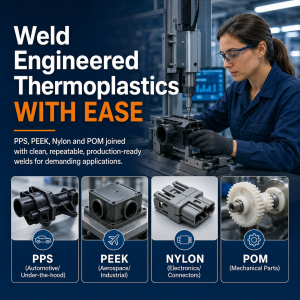
Engineered thermoplastics such as PPS, glass-filled Nylon, PBT, PEEK, POM, and other filled plastics are commonly used in demanding applications that require strength, heat resistance, chemical resistance, dimensional stability, and long-term performance. However, these same material properties can make them difficult to join, especially when assemblies require structural strength, leak-tight sealing, complex geometries, or compatibility with fillers and reinforcements.
The resources below break down common joining methods for engineered thermoplastics, where processes like ultrasonic welding, laser welding, adhesives, fasteners, and hot plate welding succeed, where they fall short, and how Emabond RF welding can be used to create strong, repeatable welds in complex engineered plastic assemblies.
Start here: Joining Methods for Engineered Thermoplastics: a complete guide to joining PPS, glass-filled Nylon, PBT, PEEK, POM, and filled plastics in complex assemblies that require structural performance, leak-tight sealing, and reliable production welding.
Plastic Welding for Large and Complex Assemblies: Irregular 3D Weld Paths, Internal Components, and Continuous Seals
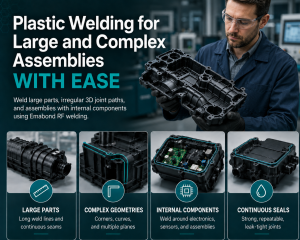
Large plastic assemblies can become difficult to weld when parts have long weld lines, irregular 3D joint paths, significant warpage, internal components, or continuous sealing requirements. These challenges can limit traditional welding processes that rely on flat tooling, direct joint access, or movement in a single plane.
The resources below cover how Emabond RF welding can be used for large and complex plastic assemblies, including long continuous seams, weld paths that turn corners or change elevation, and housings containing electronics or other internal components.
Start here: Plastic Welding for Large and Complex Assemblies — a complete guide to welding large, irregular plastic parts that require continuous seals, complex joint geometry, and reliable production welding.
Metal-to-Plastic Conversion: Welding and Sealing Thermoplastic Assemblies
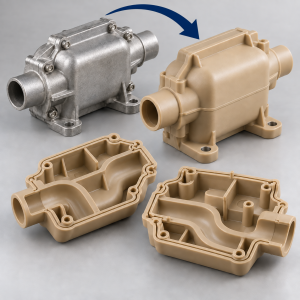
Replacing metal with engineering thermoplastics can reduce weight, improve corrosion resistance, and enable more complex part designs. However, assembling these components introduces challenges involving joint strength, continuous sealing, reinforced materials, and performance under pressure or temperature changes.
The resources below cover how Emabond RF welding can support metal-to-plastic conversion projects, including molded housings, pump bodies, valves, and fluid-handling assemblies. Explore material selection, weld joint design, and testing considerations for strong, leak-tight plastic assemblies.
Start here: Metal-to-Plastic Conversion: Welding and Sealing Thermoplastic Assemblies — an engineering guide to designing and joining plastic components for applications traditionally served by metal.
More coming soon…